
7 solar myths Indian homeowners still believe — and why they're wrong

Solar has been mainstream in India for a decade, yet the same seven objections come up on almost every site visit. Most of them were true once. None of them are true now.
1. “Panels don't work during the monsoon”
They work — just less. Output drops on heavily overcast days, but photovoltaic panels run on daylight, not heat, and diffuse light still generates power. A Bengaluru rooftop that averages around five peak sun hours in March will still deliver roughly half that through a wet July week.
Annual sizing already accounts for this. Your system is designed against a yearly generation figure, so the monsoon dip is offset by the surplus you bank in the dry months through net metering.
Rain is actually useful — it washes off the soiling that quietly costs you output for the rest of the year.
2. “Solar will damage my roof”
A correctly engineered mounting structure spreads load across the slab and is ballasted or anchored to a tested specification. Atria uses an IIT-certified structure rated for local wind loads. The panels shade the surface beneath them, which reduces thermal cycling — the thing that actually ages a roof.
3. “It needs constant cleaning”
Soiling is real and can cost 10–15% of output if ignored for a year. But “constant” overstates it: a wash every quarter is enough in most urban settings. Our installs include five years of no-cost quarterly preventive maintenance, so this is handled.
4. “The subsidy never actually arrives”
Under PM Surya Ghar the subsidy is credited directly to your bank account after commissioning and DISCOM inspection — up to ₹78,000 depending on system size. The delays people describe almost always trace back to incomplete portal paperwork.
- Register on the national portal with correct DISCOM details
- Install through an empanelled vendor
- Complete net metering and inspection
- Submit bank details to release the claim
5. “Bigger is always better”
Past the point where your system covers your consumption, each extra panel earns less, because export tariffs are lower than the retail rate you avoid by self-consuming. Size against your actual bill, not the free roof area.
6. “Batteries are essential”
For a grid-connected home with reliable supply, an on-grid system gives the best return — the grid acts as your battery through net metering. Storage earns its place when outages are frequent or you need genuine backup, which is where a hybrid system makes sense.
7. “The technology will be obsolete in five years”
Panels degrade slowly and predictably — typically under 0.5% a year, with performance warranties running 25 years. Inverters are the shorter-lived component and are straightforward to replace. The economics are set by the day you install, and the subsidy window is finite.
So what actually matters?
Three things: honest sizing against your real consumption, certified components with warranties you can read, and an installer who files the paperwork properly. Everything else on this list is noise.
Keep Reading
Related articles.
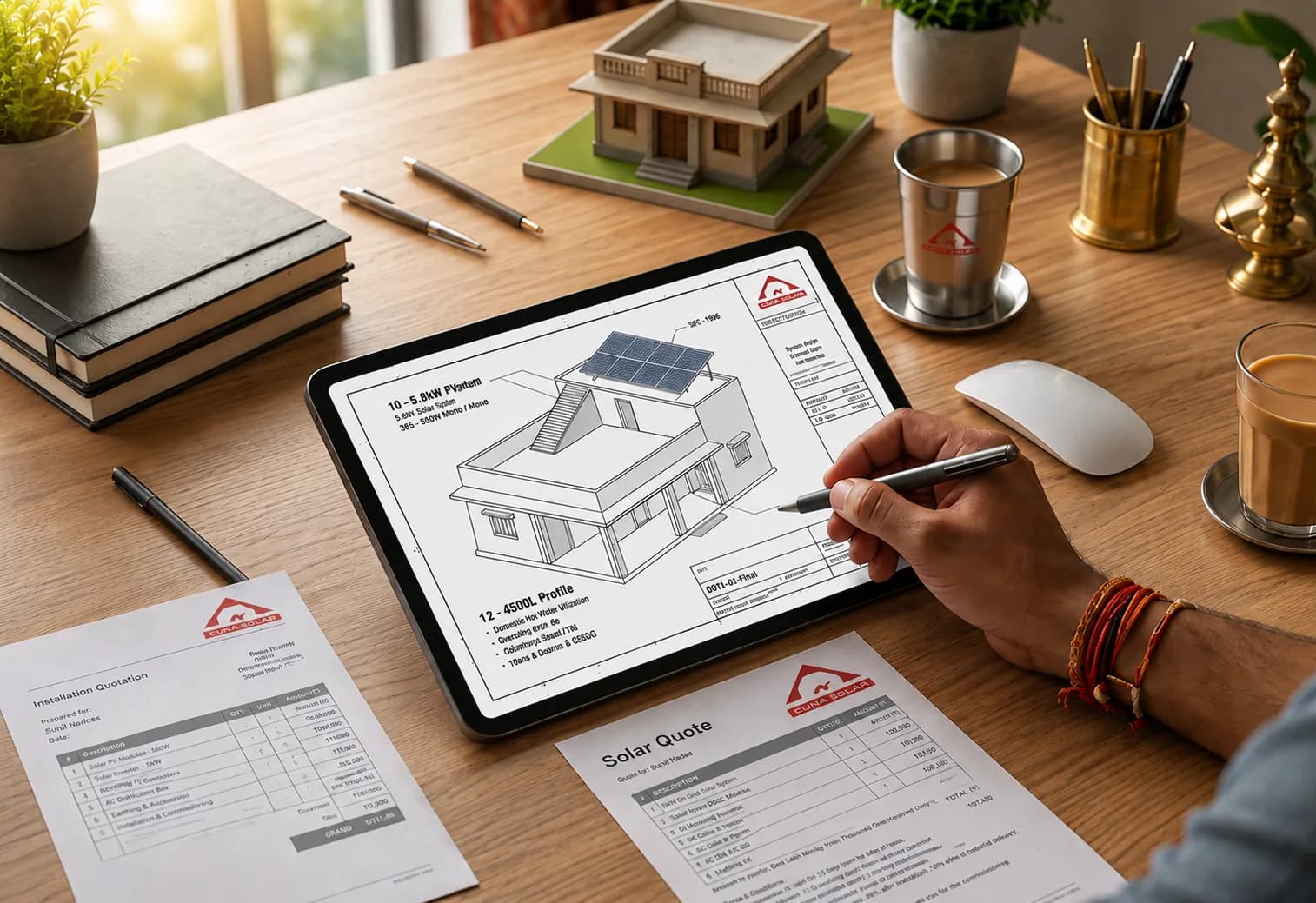 Sizing
Do bigger solar systems actually work better?
Oversizing feels safe, but past a point every extra panel earns less. Here's how to size against your real consumption.
 Hybrid
Monsoon-ready battery storage: backup power when it rains
Hybrid systems earn their keep in a Bengaluru monsoon. Sizing backup for the days the sun doesn't show up.
 Buying Guide
Top 5 warranties to look for when picking panels
Product, performance, workmanship, inverter and BOS — the five documents that decide what year 12 looks like.

Still have a question we didn't answer?
Book a free site assessment — our engineers answer in person, on your roof.
Request a Call