

How to Choose from the Top 10 Solar Companies in Bangalore
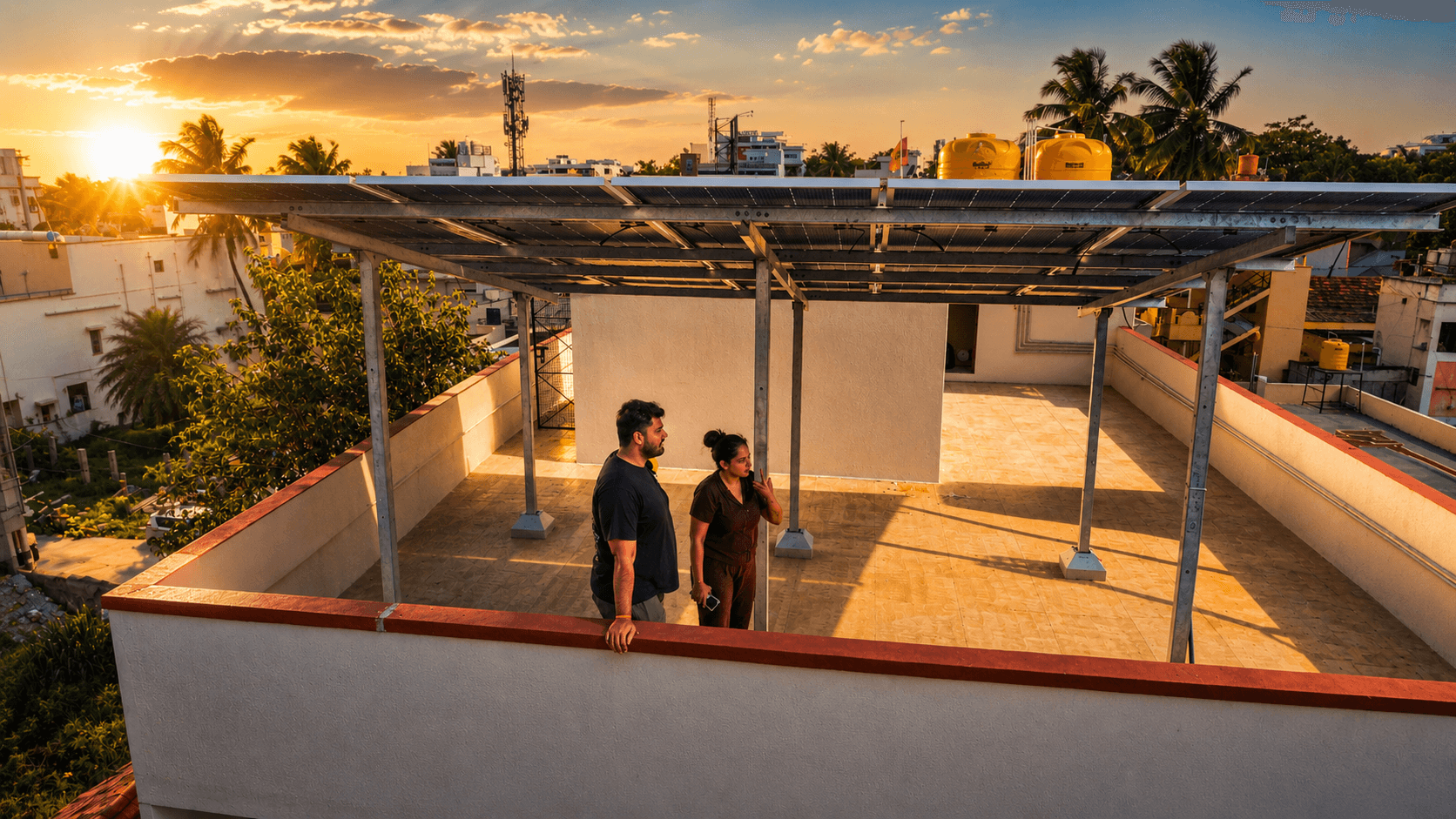
Most weeks, someone calls Atria after staring at a BESCOM bill that just crossed a line they didn’t know they’d drawn. A bill that used to sit around ₹2,000 or ₹2,500 suddenly reads ₹4,000, and that’s usually the evening the Googling starts.
Search “top 10 solar companies in Bangalore” and Atria Renewable is one of the names that comes up, but before covering why people choose it, here’s how to choose the right one, whoever you end up choosing.
What “top 10 solar companies in Bangalore” actually means
Search that phrase and you get two kinds of results. One is a “top 10 solar companies in Bangalore” listicle: ten logos, ten star ratings, no real explanation of why any of them made the cut.
The other is a single company’s own page, dressed up as unbiased advice. This piece risks the same read, so the criteria come first, and Atria’s own listing comes later, for you to judge against them.
A genuinely useful answer names the things that separate a company still taking your call in year four from one that vanishes after the subsidy cheque clears: MNRE and DCR certification, whether BESCOM approvals are handled in-house, whether the payback numbers are written down anywhere, and what happens when a panel underperforms in year three.
In short
Bangalore has no shortage of solar installers, but among the many solar installation companies in Bangalore, very few clear a six-point bar: proper certification, in-house BESCOM liaison, a written payback estimate, a real maintenance plan, transparent line-item pricing and a track record you can verify. Atria has built its process around clearing all six, and shows its working rather than just claiming it.
Atria holds a 4.9 star Google rating from 96 reviews, and ranks top of its district on the government’s own PM Surya Ghar vendor portal too — the full breakdown is a few sections down. Below is a walk-through of the criteria, the checks, and one customer’s actual numbers.
Six things worth checking before you sign anything
1. Certification that isn’t just a logo on the website
MNRE registration and DCR-compliant panels aren’t optional extras; they decide whether you qualify for the PM Surya Ghar subsidy at all.
Look the installer up directly on the PM Surya Ghar portal, and ask for the DCR panel certificate specifically. A company that hesitates here is telling you something.
2. Who actually deals with BESCOM
Net metering approval, the feasibility report, the power purchase agreement, the commissioning certificate; every rooftop system in Bangalore needs all four from BESCOM before it goes live. This paperwork can stall for weeks when it is outsourced rather than handled directly — see what BESCOM actually allows in 2026 for the detail.
Atria keeps this in-house for exactly that reason, and it’s worth asking any installer directly whether theirs is too.
3. A payback estimate in writing, not a sales pitch
Every installer will tell you solar pays for itself in four to six years. Fewer will put that number on paper against your actual roof size, your consumption, and current tariff rates.
If the number only exists as something said out loud in a sales call, treat it as marketing.
4. What happens after year one
Panels degrade slowly, typically under one percent a year, so a system is still producing meaningfully after twenty five years. The inverter is usually the part that needs attention first.
Ask what a post-warranty repair visit costs before you need one.
5. Pricing you can actually itemise
A quote that says “₹1.8 lakh, all inclusive” tells you nothing. A proper one breaks down panel cost, inverter, mounting structure, cabling, earthing and labour separately, so you can compare it line by line against a competitor’s.
Atria’s own pricing, for instance, adds no extra charge for DC or AC cabling or earthing — costs that can otherwise get folded into a vaguer, higher line item.
6. Whether “best solar company in Bangalore” claims hold up
Every second website calls itself the best solar company in Bangalore, and that claim alone is worth nothing. What matters is whether you can find named customers, with locations, talking about specific numbers. For the fuller picture on vetting an installer’s track record, see how to choose the best solar installer in Bengaluru.
Later in this piece is one such customer, checked against his actual recording rather than paraphrased.
A quick verification checklist
Before you sign, confirm each of these: MNRE and DCR certification numbers, a written payback estimate tied to your roof and your bill, an itemised quote with no bundled “miscellaneous” line, a stated workmanship warranty period, in-house BESCOM handling, and at least two verifiable customer references with real names and localities.
Six checks, five minutes each; run any of the solar installation companies in Bangalore you’re weighing up through this list before you sign.
Where Atria fits into this
Atria Renewable is the rooftop solar arm of the Atria Group, a Bengaluru business going back to 1960, the same group that built India’s first private hydro power plant and later founded ACT Fibernet.
Atria Renewable itself was incorporated in April 2021, but the parent company’s history in Karnataka’s power sector runs back six and a half decades.
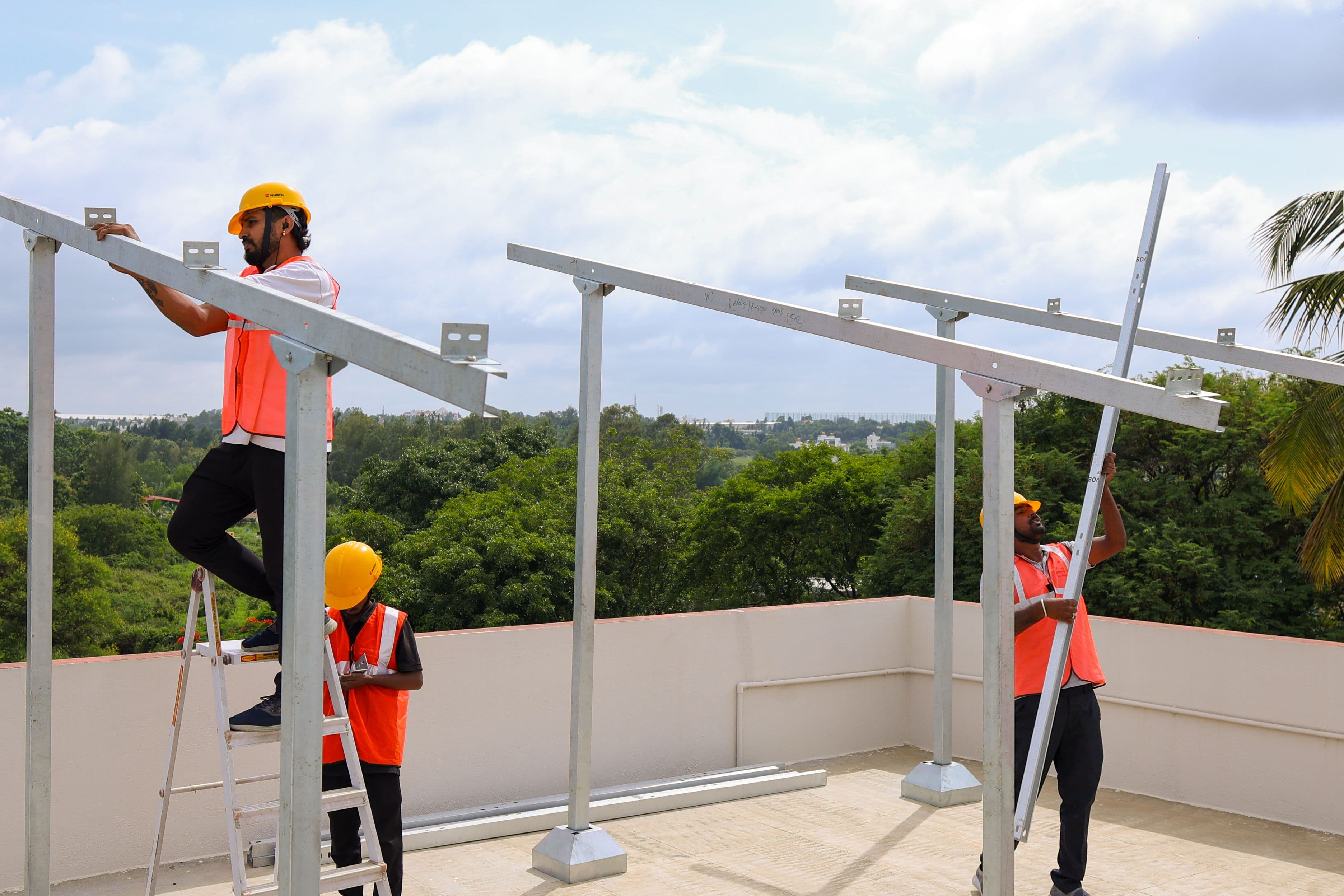
On the numbers that matter to a homeowner: installation typically takes about five hours, with commissioning completed the same day — see how the process actually works. Tidyhe mounting structure is IIT-certified, the panels are DCR-compliant, and the workmanship warranty runs five years, against the one year that’s standard elsewhere.
Atria customers track their own generation through the Namma Atria app, which shows daily, weekly and monthly output alongside estimated savings.
Atria’s rating on the government’s own portal
Google reviews are hard to fake at scale, and Atria currently holds a 4.9 star rating from 96 reviews; search “Atria Renewable” and check the review count and dates yourself.
A rating that’s harder to game sits on the PM Surya Ghar national portal itself, where every empanelled vendor is scored by homeowners who actually went through with an installation.
For Bengaluru Urban district, Atria shows a 5 out of 5 rating from 462 reviews, with 468 completed installations and 1,620 kWp of total capacity installed under its name.
This one is easy to verify independently: search the PM Surya Ghar national portal, filter for Karnataka and Bengaluru Urban, and look up any installer by name, Atria included.
The PM Surya Ghar subsidy, in plain terms
The PM Surya Ghar Muft Bijli Yojana currently offers up to ₹78,000 in central government subsidy for residential rooftop solar, and the scheme runs until 31 March 2027, though the government can extend, revise or retier it, so it is worth checking the current terms on the MNRE or PM Surya Ghar portal before relying on this figure. The amount is tiered by system size: ₹30,000 for 1kW, ₹60,000 for 2kW, and the full ₹78,000 for 3kW and above, with no further increase past that tier.
The subsidy is paid by direct benefit transfer straight into your bank account, typically within fifteen to thirty days of commissioning. A good installer handles this paperwork alongside the BESCOM approvals, so you aren’t running two bureaucratic processes on your own; Atria folds this into its standard process rather than treating it as an add-on.
One customer’s actual numbers
Bhushan is a software engineer who lives in AECS Layout, Singasandra, with his family of three, and he’s been in that home for about five years.
His BESCOM bill used to run ₹2,000 to ₹2,500 a month before he switched to Atria, and this is what he said afterwards, transcribed from his own testimonial recording rather than paraphrased:
Before installing solar, my BESCOM bill used to be around two to two and a half thousand rupees a month. Now, it’s zero. The installation and commissioning took place within a day, and they gave me the solution I needed, so I’d recommend Atria to my friends and relatives.
He checks his generation through the Atria app most days; his system produces around ten to eleven units daily, rain included, and the weekly and monthly graphs make the pattern easy to see.
What to do next
If your BESCOM bill has been climbing, the honest first step isn’t picking an installer. It’s getting a free site assessment, so you know your actual roof capacity and a realistic system size before anyone quotes you a number.
Atria offers this at no cost; you can book one by calling +91 99011 00428 or through the free site survey page. Bring your last three BESCOM bills to that call, since it gives Atria real figures to work from instead of estimates.
Whichever name on a “top 10 solar companies in Bangalore” list you eventually pick, run it through the six checks above first, since the fifteen minutes it takes is cheaper than a bad quote you’re stuck with for twenty five years. For more on installers, subsidies and BESCOM rules, the Atria blog covers each in more depth.
REFERENCES
- PM Surya Ghar national portal — vendor ratings for Bengaluru Urban district (Atria: 5/5, 462 reviews, 468 installations): https://pmsuryaghar.gov.in/
- Atria Renewable — PM Surya Ghar Yojana page: https://www.atriarenewable.com/pm-surya-ghar-yojana/
- Atria Renewable — About Us / Atria Group history: https://www.atriarenewable.com/about-us/
- Atria Renewable — free site survey / assessment booking: https://www.atriarenewable.com/free/site_survey
- Atria Renewable — blog index: https://www.atriarenewable.com/blog/
- Bhushan’s customer testimonial https://www.youtube.com/watch?v=gu4cn6GHJfI
- Google Business Profile rating for Atria Renewable (4.9★, 96 reviews)
Keep Reading
Related articles.
 Journal
How to choose the best Solar Installer in Bengaluru?
Choosing the right solar installer is as important as the technology, as it directly impacts efficiency, safety, and long-term savings. Focus on value over cost—cheaper installations can lead to poor quality, lower performance, and higher maintenance in the long run. Select an installer with local expertise in Bengaluru, ensuring proper design, compliance with BESCOM regulations, and efficient execution. Evaluate technology, quality, and end-to-end services, including panels, inverters, warranties, approvals, installation, and ongoing support. Prioritize after-sales service, transparency, and proven track record to ensure long-term reliability, better ROI, and a hassle-free experience.
 Journal
Home Solar Installation in Bangalore: How the Process Actually Works
Table of Contents Highlights of This Article Introduction Who This Guide Is For What Does Home Solar Installation Actually Involve? The 5 Steps of Home Solar Installation in Bangalore So How Long Does Home Solar Installation Actually Take? The Bottom Line Frequently Asked Questions References
 Solar
SolarNet Metering in Bangalore: What BESCOM Allows in 2026 (and What Most EPCs Don’t Explain)
Homeowners in Bangalore often think going solar is simple, until (net metering) enters the picture. That’s when the questions start. How much solar capacity will (BESCOM) actually approve? Could your current power allowance be sufficient? What makes certain houses sit inactive for weeks, sometimes even months? When do the actual savings begin? One thing's certain. Plenty of people in Bangalore dig into (net metering inBangalore) these days. Whether your roof’s solar setupactually saves money hinges on how net metering works. By 2026, (BESCOM net metering) rules are clearly defined. Still, many homeowners understand these details too late, after the panels are already installed. This guide walks through BESCOM's rules, common missteps in filings, while showing how quicker setup boosts returns.

Still have a question we didn't answer?
Book a free site assessment — our engineers answer in person, on your roof.
Request a Call