

Does Rain Help or Hurt the Solar Panels?
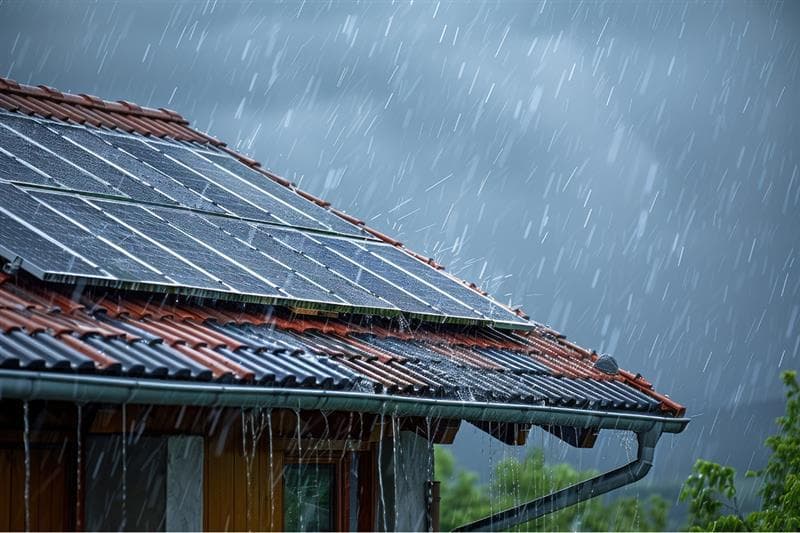
Every time the sky opens up over Bangalore, solar panel owners ask the same question: Is this good or bad for my system? A few think this through even before installing rooftop solar in their homes. The honest answer is it's both. Rain is one of nature's most nuanced forces when it comes to solar energy, and in a city shaped by two distinct monsoon seasons, understanding the relationship between rainfall and panel performance could meaningfully change how you manage, select and make the best out of your system.
Let us look at the major benefits and drawbacks that rain brings to rooftop home solar systems during rainy season or whenever it rains in Bengaluru.
Rain cleaning solar panels: Natural maintenance-
Solar panels are exposed to the elements 365 days a year. Over weeks and months, dust, bird droppings, pollen, and pollution form a fine film across the glass surface. This film isn't cosmetic — it actively reduces the amount of sunlight that reaches the photovoltaic cells beneath, dragging down your energy output. Rain, in this context, acts as a free cleaning service. For residential homeowners, this is free automatic cleaning. You don't pay for it, you don't schedule it, it just happens. It matters most in regions where dust is relentless or where pollen and salt spray are problems. In those climates, you're not just getting backup power on rainy days. You're getting months of accumulated dirt scrubbed away.
Temperature and cooling benefits-
Here's a benefit of rain that often gets overlooked: cooler panels are more efficient panels. Cooler temperatures can improve efficiency in solar installations. This matters a lot more than people realize.
Silicon cells lose efficiency as they heat up. For every degree Celsius above 25°C, efficiency drops roughly 0.5%. It's not a dramatic change per degree, but it compounds fast. In hot climates, this is a real cost. When rain falls and cools your panels, you recover some of that lost efficiency even as cloud cover temporarily reduces light penetration.
For Bangalore and similar tropical regions, this cooling effect is the real win. A monsoon rain that drops panel temperature by 10°C can recover about 5% of the efficiency that the heat was costing you. This is why monsoon season isn't the disaster for your home solar that some people expect.
Now that we have seen the major benefits of rain for home solar, now let us take a look into how it tampers with the efficiency of the solar. The rain has both good and bad faces when we pair it with rooftop home solar.
Reduces Irradiance-
On a clear day, solar panels receive direct solar radiation, where sunlight travels in a straight path from the sun to the panel surface. This form of radiation is highly concentrated and carries maximum energy, allowing photovoltaic (PV) cells to operate at peak efficiency. However, during cloudy or rainy conditions, dense cloud cover acts as a barrier that blocks, absorbs, and scatters sunlight. As a result, the panels receive predominantly diffused sunlight, which is weaker, less concentrated, and arrives from multiple angles rather than directly.
This shift from direct to diffused radiation significantly impacts energy generation. Since solar panels rely on the intensity of sunlight (irradiance) to produce electricity, even a moderate reduction in light intensity can lead to a noticeable drop in output. In cases of light cloud cover, the reduction may be minimal, but during dense monsoon clouds or prolonged rainy periods, the drop can easily reach 30–50%, and in extreme conditions, even lower for short durations.
Incomplete cleaning-
While rain does assist in cleaning solar panels, it is not effective in removing stubborn debris such as bird droppings, sticky pollutants, oil films, and industrial residue. Therefore, despite the rain, it is essential to address these persistent contaminants. Regular maintenance and inspection of home solar panels are crucial for ensuring their longevity and optimal performance. Light rain showers often fail to wash away heavy dust entirely, instead mixing it into a thin layer of mud that can bake onto the glass once the sun returns, blocking more light than the original dry dust.
For a quick recap and clearer understanding, the table below brings together the key advantages and limitations of rain on solar panels in one place. It serves as a simple yet effective guide for homeowners who are evaluating rooftop solar, especially in climates with seasonal rainfall like Bangalore.
Ultimately, the goal is not to judge solar performance based on a single rainy day but to understand how it performs across different weather conditions throughout the year. This holistic view is essential when considering rooftop solar as a long-term investment for your home.
Think of Bangalore's rains not as a threat, but as a seasonal maintenance cycle that nature provides for free. Your job is to plan around it – with good panel orientation, occasional manual cleaning, and appropriate battery sizing – and let the sun do the rest when it returns. Service providers like Atria provide cleaning services for your rooftop home solar panels. You do not have to get into the process of continuous calls or texts to anyone, but with just a few clicks, schedule the service via the “Namma Atria” app, and it is done for you.
Keep Reading
Related articles.
 Tips
TipsWhy Is Your Rooftop Solar System Losing Power?
7 Common Causes of Generation Loss How to predict and prevent them from happening Factors that cause the generation loss
 Tips
Tips7 Things That Might Become Red Flags In Your Solar Journey
7 critical factors that can become costly red flags if overlooked during your solar journey. False promises by the installers, no proper warranty checks or site assessments, and lack of equipment knowledge. What to ask and what to know?
 Tips
TipsIs Your Home Ready for Rooftop Solar?
A Complete Checklist for Homeowners in Bengaluru Find the checklist to install rooftop solar in Bengaluru. Mandatory permissions and prerequisites.

Still have a question we didn't answer?
Book a free site assessment — our engineers answer in person, on your roof.
Request a Call