

Solar on Rooftop: A Bengaluru Homeowner's Overview

QUICK ANSWER
Solar on rooftop is a system of solar panels fitted to a home's roof to generate its own rooftop solar power from sunlight, feeding the home directly and exporting any surplus to the grid through net metering. It typically includes panels, an inverter, a mounting structure, and a bidirectional meter. In Bengaluru, system size and eligibility depend on roof suitability, sanctioned load, and the PM Surya Ghar subsidy. Atria Renewable installs these rooftop solar systems for homes across the city.
What She Actually Bought
Janet Jagdish lives in Koramangala 1st Block. Before she installed rooftop solar, her electricity bill ran to around ₹3,000 a month; it is now close to zero, as she described in a customer testimonial published on Atria Renewable's official YouTube channel.
She reached that outcome deliberately. She heard about Atria through family and friends, then approached a couple of vendors before deciding on Atria's panels for her house.
Her story is a useful guide, because a search for solar on rooftop mostly turns up either a long FAQ that never mentions the government subsidy, or a sales page quoting a subsidy formula. Neither tells you what Janet actually had to work out: whether her own roof, in her own part of Bengaluru, qualified, and what the numbers would look like once it did.
The mechanics are simple enough — panels, an inverter, a mounting structure, and a bidirectional meter, as the Quick Answer above lays out. The real work sits in the specifics: whether the roof qualifies, and whether the subsidy maths holds up. Atria Renewable installs these systems for homes across Bengaluru, which is the service Janet used.
Most homes with a reliable grid connection choose an on-grid system: no battery, lower cost, with any surplus credited back through net metering.
A hybrid system adds battery storage for backup during outages, worth considering if an area sees frequent power cuts. For most independent houses in Bengaluru, on-grid is the more cost-effective, more common choice. For the full trade-off between the two, see the post: On-Grid Solar vs Off-Grid Solar.
Why Her Roof Needed Customising
Janet's roof sits on different levels, so the installation had to be customised rather than following a standard layout. That single detail is exactly what a suitability check exists to catch.
Atria publishes clear criteria for what counts as workable: roughly 10 square metres of usable, shadow-free roof space per kilowatt of system size; minimal shading between 9am and 4pm, when most of the day's generation happens; a structure able to bear 15 to 20 kilograms per square metre; and a roof type of RCC, metal sheet, or tile. (Read more: Atria's FAQ)
Orientation matters too; for Bengaluru, panels facing south at a tilt of roughly 12 to 13 degrees generate the most, and a site engineer adjusts for the roof's actual layout during a survey. The roof-area required is 108 sq ft per kw.
Want the full pre-installation checklist, including your BESCOM rooftop solar connection rules and roof-ownership requirements? See our cluster guide, Is Your Home Ready for Rooftop Solar?.
Sizing and the Numbers
System size for a rooftop solar system tracks average monthly consumption and sanctioned load, the maximum power a connection is registered to draw. Atria's own bands run 0 to 150 units a month for a 1 to 2 kW system, 150 to 300 units for 2 to 3 kW, and above 300 units for 3 kW or more.
Take a home using 280 units a month as an illustration: that sits inside the 150-to-300 band, so a 3 kW system is a reasonable fit. Bengaluru's average generation runs 4 to 4.5 units per kW per day, so at 4.25 units, a roof top solar system of 3 kW produces 3 × 4.25 = 12.75 units a day, or 12.75 × 30 = 382 units a month, comfortably covering that draw with some left over to export from the rooftop PV panels (Read more: Atria's FAQ).
What It Costs, and What the Subsidy Actually Is
Atria's residential systems range from 1.77 kW to 5.31 kW (Read more: Atria's FAQ). The PM Surya Ghar Muft Bijli Yojana subsidy pays a fixed rupee amount, calculated per kilowatt: ₹30,000 for each of the first two kilowatts, then ₹18,000 for a third, capped at ₹78,000 above 3 kW. An installer quoting it as a percentage of system cost is working from information that predates the current scheme.
After the subsidy, Atria states an effective price of roughly ₹1.20 lakh to ₹2.50 lakh depending on system size, with payback typically running 3 to 5 years. The subsidy only applies through a vendor empanelled for the scheme. But, Atria handles the entire application on the homeowner's behalf, at no extra charge, the same handling Janet described for her own paperwork. Atria’s PM Surya Ghar Yojana page breaks the same subsidy down by consumption band — a fuller solar rooftop price list by system size sits in the table below, matching the per-kW maths above.
Key Numbers at a Glance
- Roof space needed : ~10 sq. m (~108 sq ft) per kW
- Structural load capacity required : 15–20 kg per sq. m
- Shading window that matters most : 9am–4pm
- System size: 0–150 units/month : 1–2 kW
- System size: 150–300 units/month : 2–3 kW
- System size: 300+ units/month : 3 kW or more
- Average generation (Bengaluru) : 4–4.5 units per kW per day
- Atria residential system range : 1.77 kW – 5.31 kW
- PM Surya Ghar subsidy cap (above 3kW) : ₹78,000
- Effective price after subsidy : ₹1.20 lakh – ₹2.50 lakh
- Typical payback period : 3–5 years
- Workmanship warranty (Atria) : 5 years (vs “usually 1 year” industry norm)
How Rooftop Solar Installation Actually Works
Once the roof qualifies and the system is sized, installation follows a defined sequence, from the first site visit to the day BESCOM switches the system on. Atria's own published breakdown of the process — our cluster post Home Solar Installation in Bengaluru: The Real Process — sets out what each stage involves and how long it actually takes.
Step 1 — Site Survey (2–4 days)
An engineer checks the roof's shadow-free area (~10 sq. m per kW), its structural load capacity (15–20 kg/sq. m), and the home's sanctioned load. Booking runs online, by phone, or through the Namma Atria app; Atria's booking payment is ₹5,000.
Step 2 — Documents and KYC (1–2 days)
Standard identity paperwork: Aadhaar, PAN, the latest electricity bill, a cancelled cheque, and roof-ownership proof if the property isn't in the applicant's name.
Step 3 — Government and BESCOM Approval (7–21 days)
Two applications run in parallel: one through the PM Surya Ghar portal for the central subsidy, and one through BESCOM's SRTPV portal for the grid connection. Once the work-completion report is uploaded, BESCOM's published procedure gives it 5 working days to inspect and commission a BESCOM rooftop solar system up to 10 kW — miss that window, and the responsible officer is liable for a ₹1,000-per-day penalty payable to the consumer.
Step 4 — Physical Installation (under 5 hours – Only Fastest Installer in India)
Panels, inverter, mounting structure, and cabling are typically installed in a single visit lasting about 5 hours.
Step 5 — Commissioning (within 48 hours)
BESCOM fits the bidirectional meter; based on Atria's own installation experience, systems are typically switched on within 48 hours of the meter being fitted.
Add up the fastest version of every stage and installation runs roughly 10 to 12 days start to finish; the slowest realistic version is closer to 29 — which is why Atria quotes “2 to 4 weeks” rather than a single fixed number. Read the full step-by-step breakdown, including the exact BESCOM penalty clause.
After the Switch Was Flipped
Once the installation was done, Atria put the meter in place and helped Janet with the name change on it. She now tracks generation, grid export, and usage through the Namma Atria app, which is how she can see how much she is saving. Her account is paraphrased from a customer testimonial published on Atria's YouTube channel.
Why Rooftop Solar Is Growing in Bengaluru and Across India
Janet's decision sits inside a much bigger national shift toward rooftop solar power. Our cluster post, Subsidy for Rooftop Solar: Is It the Only Catalyst for Growth?, lays out the scale of it. By the numbers:
- India added 7.1 GW of new rooftop solar capacity in 2025 alone — a 123% increase over 2024 — taking cumulative installed rooftop solar past 20.8 GW nationally.
- By May 2026, more than 32 lakh households had used the PM Surya Ghar Muft Bijli Yojana subsidy since its February 2024 launch.
- The residential segment accounted for 76% of all new rooftop solar installations in India in 2025.
- The PM Surya Ghar subsidy is scheduled to run only until 31 March 2027 — confirm the current deadline before treating it as final, as government scheme dates can change.
Atria vs. a Typical EPC: What Actually Differs
What to Ask, If You Are Where Janet Was
A vendor comparison like hers surfaces a handful of questions worth taking to every installer on a shortlist.
- Ask for the workmanship warranty in writing, separately from the panel and inverter warranties; Atria offers a 5-year workmanship warranty against an industry norm it describes as usually 1 year, per Why Atria.
- Ask whether the mounting structure is independently certified: Atria panel structures are IIT-certified, and any installer using a different method should be able to point to comparable backing, in writing.
- Ask whether the panels are DCR-certified, meaning domestically manufactured and eligible under the subsidy scheme; Atria panels are DCR-certified and notes this is a point where other EPCs sometimes fall short.
- Ask whether the subsidy paperwork is handled for you, the way it was for Janet, or left for you to chase. And ask whether on-grid or hybrid actually matches how often the area loses power, rather than defaulting to whichever the installer finds easier to quote.
The Bottom Line
Solar on rooftop for an independent house in Bengaluru comes down to the same three checks Janet's own search worked through:
- Does the roof physically qualify,
- Is the rooftop solar system sized to the actual bill rather than a round number, and
- Does the subsidy maths add up the way the installer says it does.
Get those three right, and the rest — the paperwork, the installation, the switch-on — becomes a matter of process, much as it did for her.
A free site survey answers the first two in a single visit. Ask for the workmanship warranty and subsidy handling in writing before committing to the third. Call : +91-9901100428
See Atria's Solar Panels — our page for rooftop solar — to start with a free site assessment.
REFERENCES (hyperlinked to the exact pages)
- PM Surya Ghar Muft Bijli Yojana, Government of India / Ministry of New and Renewable Energy — official portal. pmsuryaghar.gov.in
- Atria Renewable — Help Centre / Solar FAQs. atriarenewable.com/faq
- Atria Renewable — Why Atria page. atriarenewable.com/why-atria
- Atria Renewable — Products page. atriarenewable.com/products
- Atria Renewable — PM Surya Ghar Yojana page. atriarenewable.com/pm-surya-ghar
- Atria Renewable — “Home Solar Installation in Bengaluru: The Real Process.” atriarenewable.com/blog/home-solar-installation-bengaluru-process
- Atria Renewable — “Is Your Home Ready for Rooftop Solar?” atriarenewable.com/blog/is-your-home-ready-for-rooftop-solar
- Atria Renewable — “On-Grid Solar vs Off-Grid Solar.” atriarenewable.com/blog/on-grid-solar-vs-off-grid-solar
- Atria Renewable, official YouTube channel — “From ₹3,000/Month to Almost Zero: Koramangala Homeowner Shares Her Solar Story,” retrieved 2026-08-11.
- Citizen Matters — “All You Want to Know About Rooftop Solar Installation in Bengaluru,” retrieved 2026-08-11.
Keep Reading
Related articles.
 Journal
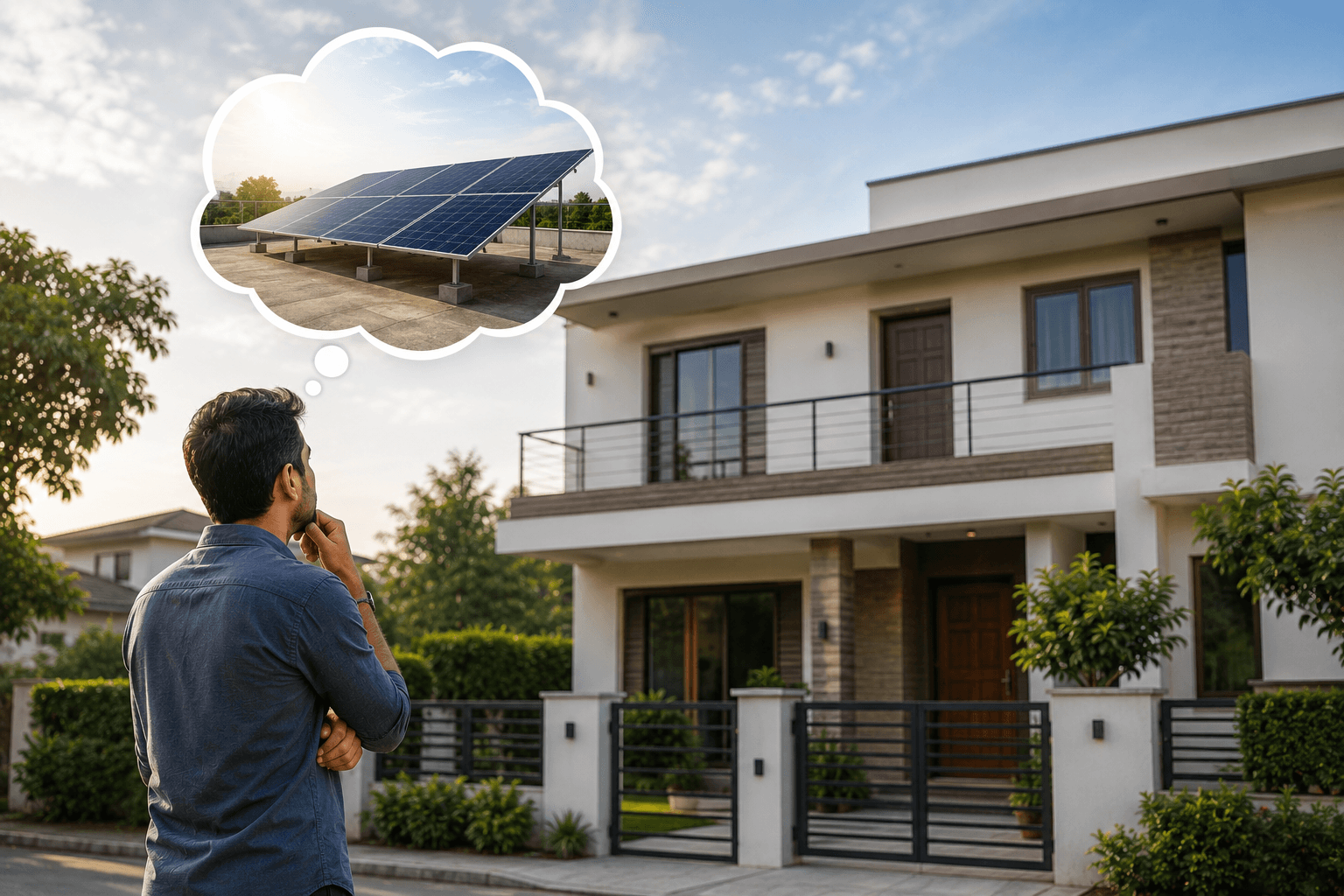
Is Your Home Ready for Rooftop Solar?
A Complete Checklist for Homeowners in Bengaluru Find the checklist to install rooftop solar in Bengaluru. Mandatory permissions and prerequisites.
 Journal
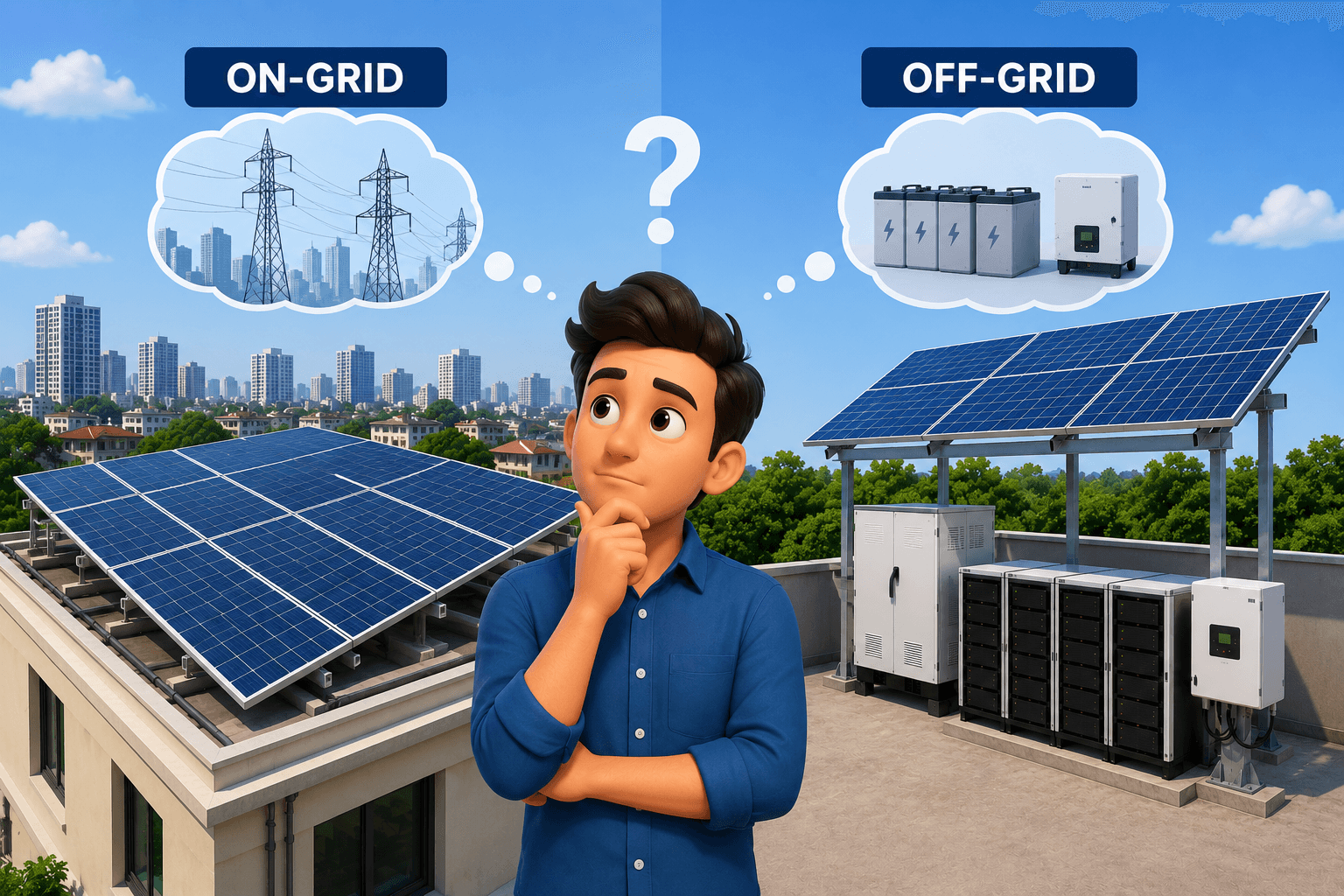
On-Grid Solar Vs Off-Grid Solar
On-grid and off-grid solar systems function differently despite both using solar energy as the primary power source. On-grid systems are more affordable and low-maintenance, making them ideal for Bengaluru homes with reliable electricity supply. Off-grid systems provide complete power independence through battery storage, but they involve higher installation and maintenance costs. Hybrid solar systems combine the benefits of both, offering grid connectivity along with battery backup for power outages. Choosing the right solar system depends on factors such as electricity reliability, energy consumption, budget, rooftop space, and backup power requirements.
 Journal
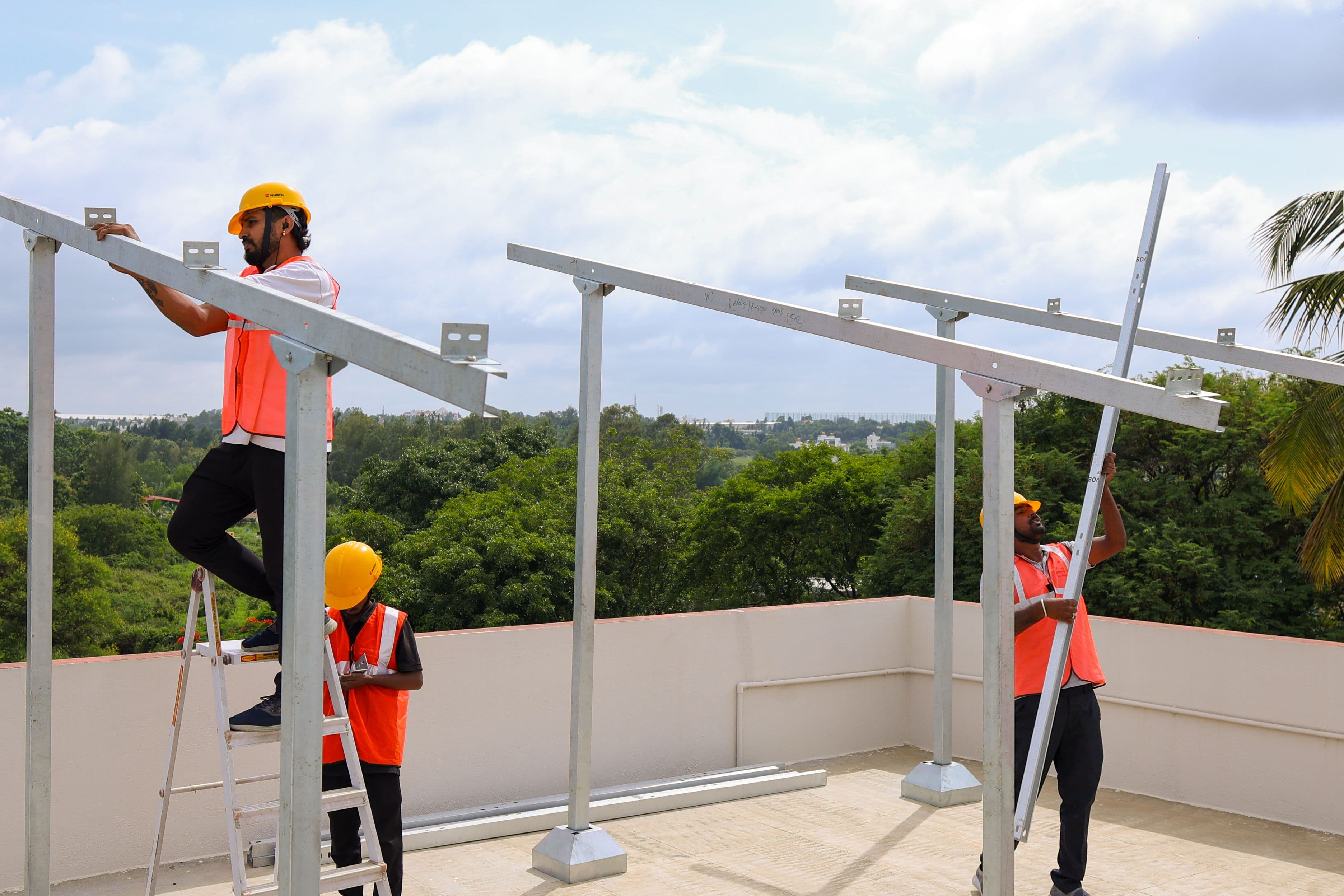
Home Solar Installation in Bangalore: How the Process Actually Works
Table of Contents Highlights of This Article Introduction Who This Guide Is For What Does Home Solar Installation Actually Involve? The 5 Steps of Home Solar Installation in Bangalore So How Long Does Home Solar Installation Actually Take? The Bottom Line Frequently Asked Questions References

Still have a question we didn't answer?
Book a free site assessment — our engineers answer in person, on your roof.
Request a Call